

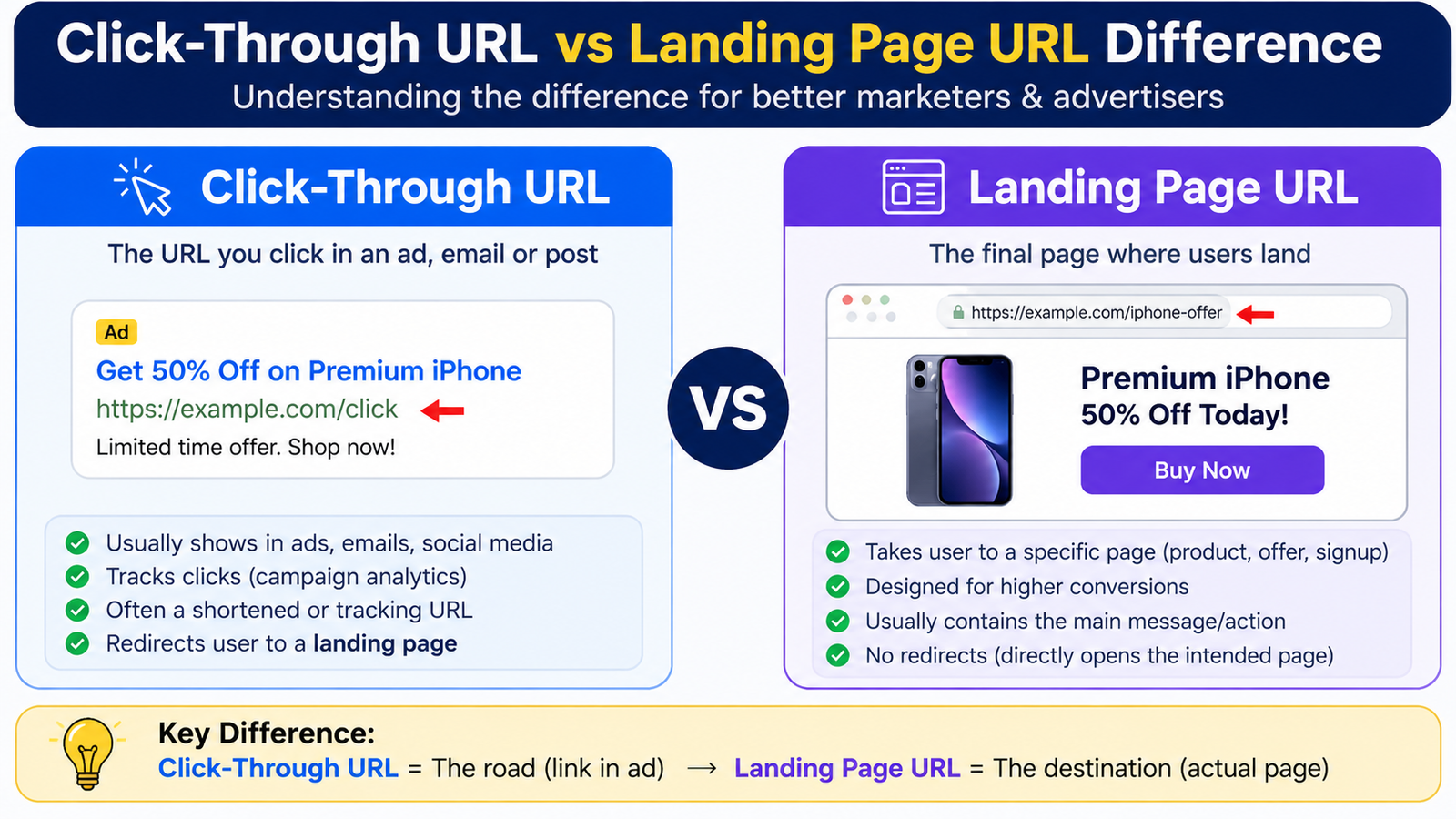
If you’ve ever created a Google Ads campaign, tracked marketing performance, or worked with affiliate links, you’ve probably come across the terms Click-Through URL and Landing Page URL. At first glance, they may seem like the same thing because both involve sending users to a webpage. However, they serve different purposes and play distinct roles in digital marketing.
Understanding the difference between these two URLs is essential for advertisers, SEO professionals, affiliate marketers, and business owners. Using them correctly improves campaign tracking, enhances user experience, and helps you measure marketing performance more accurately. Click-Through URL vs Landing Page URL Difference
In this guide, we’ll explain the click-through URL vs landing page URL difference in simple language while also covering practical examples, benefits, best practices, and common mistakes.
What Is a Click-Through URL?
A Click-Through URL is the URL that users initially click when interacting with an advertisement, email, social media post, banner, or affiliate link. This URL often includes tracking parameters or redirects before the visitor reaches the final destination.
Unlike a standard webpage URL, a click-through URL is mainly designed for tracking user interactions. Marketers use it to monitor how many people clicked an ad, where the traffic came from, which campaign generated the click, and which keywords performed best.
For example, instead of directly linking to: Click-Through URL vs Landing Page URL Difference
an advertiser might use:
This tracking link records the click before forwarding the visitor to the landing page. Click-Through URL vs Landing Page URL Difference
The biggest advantage of click-through URLs is the ability to collect valuable marketing data. Businesses can analyze traffic sources, compare advertising campaigns, and optimize future marketing strategies based on accurate performance metrics.
Many advertising platforms automatically generate click-through URLs. Google Ads, Facebook Ads, Microsoft Advertising, affiliate networks, and email marketing tools all rely on some form of click tracking.
Click-through URLs are generally invisible to users because the redirect happens almost instantly. The visitor rarely notices the transition unless the tracking process takes too long. Click-Through URL vs Landing Page URL Difference
Their primary goal is measurement, not user engagement.
What Is a Landing Page URL?
A Landing Page URL is the actual webpage where visitors arrive after clicking an advertisement or marketing link. It is the page designed to deliver information, encourage conversions, or complete a specific business objective.
Unlike click-through URLs, landing page URLs are meant for the user rather than marketers. Click-Through URL vs Landing Page URL Difference
For example:
This page may contain product information, pricing, customer reviews, images, and a “Buy Now” button.
Landing pages are carefully optimized to match the visitor’s expectations. If someone clicks an advertisement promoting running shoes, the landing page should display running shoes—not a general homepage. Click-Through URL vs Landing Page URL Difference
A relevant landing page increases user satisfaction while also improving conversion rates.
Businesses often create dedicated landing pages for: Click-Through URL vs Landing Page URL Difference
- Product launches
- Lead generation
- Webinar registration
- Newsletter subscriptions
- Event sign-ups
- Software downloads
- Promotional offers
The better the landing page matches the advertisement, the higher the chances of converting visitors into customers.
Click-Through URL vs Landing Page URL: The Main Difference
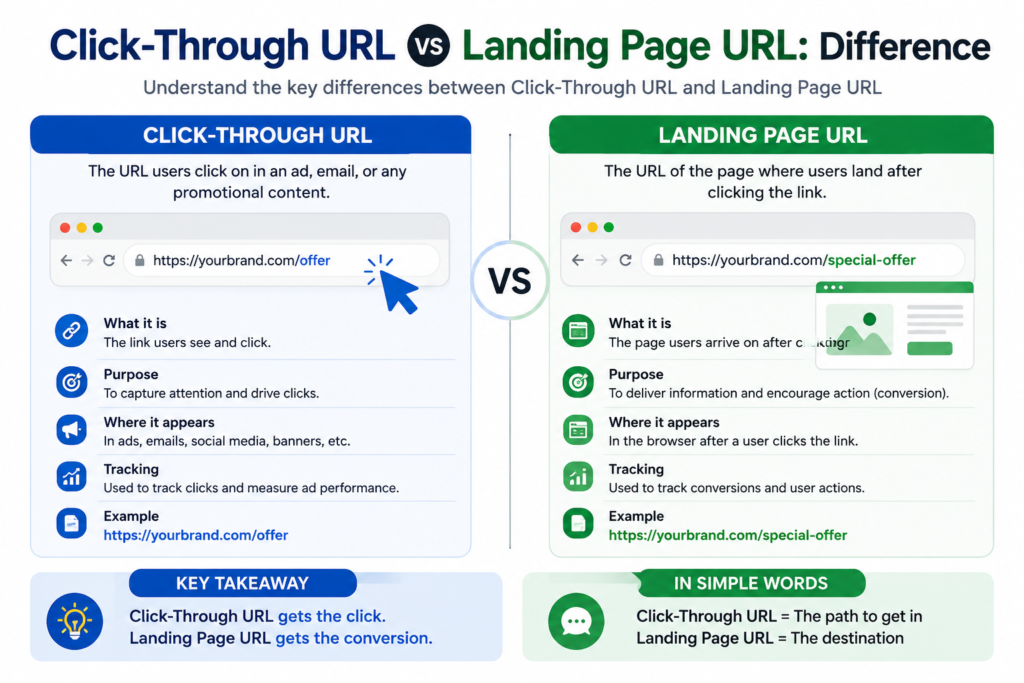
The Click-Through URL and Landing Page URL simplest way to understand the difference is this:
- A Click-Through URL records the click.
- A Landing Page URL displays the content.
The click-through URL works behind the scenes for tracking purposes, while the landing page URL is where users actually spend their time.
Imagine ordering food through a delivery app. Click-Through URL vs Landing Page URL Difference
The app records your order before sending it to the restaurant. That recording step is similar to the click-through URL. The restaurant where your meal is prepared represents the landing page. Click-Through URL vs Landing Page URL Difference
Another way to think about it is using package delivery.
The shipping company scans your package at different checkpoints. Those scans are similar to click tracking. The final destination where the package is delivered is like the landing page.
Both steps are important but serve completely different purposes.
Without click tracking, marketers wouldn’t know which advertisements generate results. Without landing pages, users would have nowhere meaningful to go after clicking.
How Click-Through URLs Work
The process is actually quite simple. Click-Through URL vs Landing Page URL Difference
When someone clicks an online advertisement, they don’t always go directly to the destination page.
Instead, the click first reaches a tracking server.
That server records information such as:
- Campaign ID
- Device type
- Browser
- Geographic location
- Keyword
- Time of click
- Ad group
- Traffic source
After recording the data, the server immediately redirects the visitor to the landing page. Click-Through URL vs Landing Page URL Difference
This entire process usually happens in less than a second.
Most users never notice the redirect because it happens almost instantly.
Modern advertising platforms have optimized these redirects to minimize delays and maintain a smooth user experience.
Tracking also allows marketers to identify which advertisements perform best. Instead of guessing, businesses can make decisions using real data.
How Landing Page URLs Work
Once the visitor reaches the landing page, the marketing focus shifts from tracking to conversion.
The landing page provides information that matches the user’s expectations. Click-Through URL vs Landing Page URL Difference
Good landing pages usually include:
- Clear headlines
- Relevant images
- Product details
- Customer testimonials
- Benefits
- Strong call-to-action buttons
- Contact forms
A well-designed landing page reduces confusion.
If someone clicks an ad promising “50% Off Running Shoes,” they should immediately see that exact offer.
Sending visitors to an unrelated page often increases bounce rates and decreases conversions. Click-Through URL vs Landing Page URL Difference
Landing pages also improve Quality Score in paid advertising platforms because relevance plays a significant role in campaign performance.
Key Differences Between Click-Through URLs and Landing Page URLs
| Feature | Click-Through URL | Landing Page URL |
| Purpose | Track clicks | Convert visitors |
| Visible to users | Usually no | Yes |
| Contains tracking | Yes | Sometimes |
| Redirects | Often | No |
| Used by marketers | Yes | Yes |
| Used by visitors | Briefly | Yes |
| Main goal | Analytics | Sales, leads, sign-ups |
Why Marketers Use Click-Through URLs
Click tracking provides valuable marketing insights.
Without it, advertisers would struggle to understand campaign performance.
Some major benefits include:
Better Campaign Tracking
Businesses can identify which advertisements generate the most clicks. Click-Through URL vs Landing Page URL Difference
Instead of relying on assumptions, marketers receive measurable data.
This improves decision-making and advertising efficiency.
Accurate Attribution
Customers often interact with multiple marketing channels before making a purchase.
Click-through URLs help determine which advertisement or campaign deserves credit for the conversion.
A/B Testing
Marketers frequently test multiple ads.
Click tracking helps compare:
- Headlines
- Images
- Calls to action
- Keywords
- Audience targeting
The winning version can then be scaled for better performance.
Why Landing Pages Matter
A great landing page can significantly improve conversion rates.
Simply getting clicks isn’t enough.
Visitors must be convinced to take action.
Landing pages eliminate unnecessary distractions.
Unlike homepages, they focus on one primary objective.
This focused design often leads to higher sales and more leads.
Landing pages also build trust.
Professional layouts, customer reviews, FAQs, guarantees, and secure checkout processes reassure visitors before they make a decision.
Common Mistakes to Avoid
Many beginners confuse these two URLs and make avoidable mistakes.
One common mistake is sending paid traffic directly to a homepage.
Visitors may struggle to find the advertised product, resulting in lost sales.
Another mistake is using unnecessary redirect chains.
Multiple redirects can slow page loading times, negatively affecting both user experience and campaign performance.
Some marketers also forget to test their tracking links.
A broken click-through URL can result in lost traffic and inaccurate campaign reporting.
Always verify that tracking links redirect visitors correctly.
Best Practices for Using Both URLs
To maximize campaign performance, follow these recommendations:
- Keep click-through tracking accurate.
- Avoid excessive redirects.
- Use descriptive landing pages.
- Match landing page content with ad copy.
- Test links before launching campaigns.
- Optimize landing pages for mobile devices.
- Improve page loading speed.
- Monitor analytics regularly.
Consistent testing is also important.
Even small improvements in landing page design can increase conversions over time.
Regularly reviewing campaign data helps identify opportunities for optimization and budget allocation.
Final Thoughts
Understanding the click-through URL vs landing page URL difference is fundamental for anyone involved in digital marketing. Although these URLs work together, they have completely different purposes.
A click-through URL focuses on tracking, analytics, and campaign measurement. It records valuable information about user interactions before directing visitors to their destination. On the other hand, a landing page URL is where visitors actually engage with your content, explore your offer, and ideally complete a desired action such as making a purchase, filling out a form, or subscribing to a newsletter.
Successful marketing campaigns rely on both. Accurate click tracking helps marketers understand what works, while an optimized landing page turns those clicks into real business results. By using click-through URLs for precise analytics and creating highly relevant landing pages for conversions, businesses can improve advertising performance, increase return on investment, and deliver a better experience for every visitor.
You May Read Also:
AdvancedBackgroundChecks.com John Smith Search Results URL Structure

