

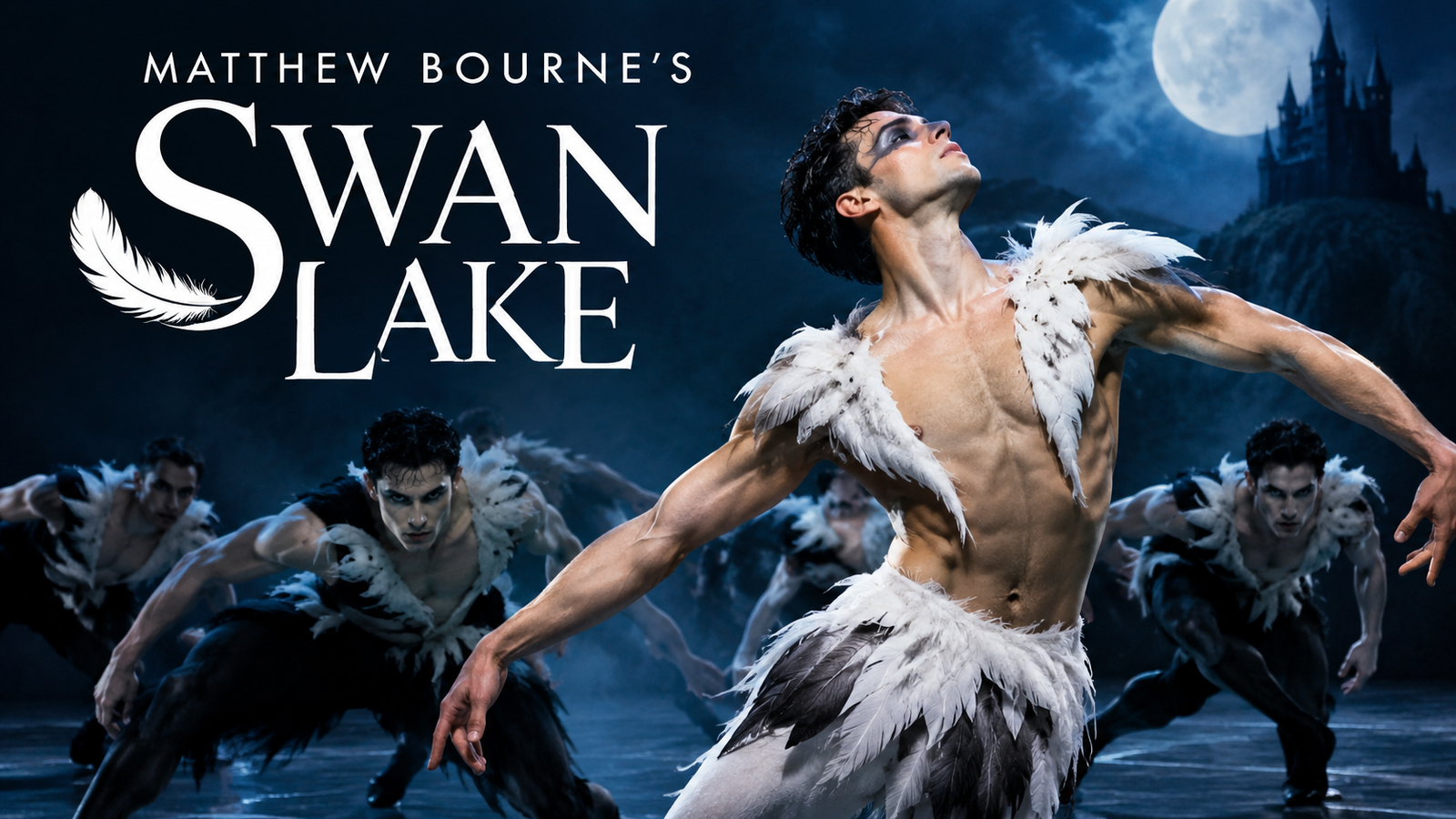
Matthew Bourne’s Swan Lake is one of the most recognizable modern reinterpretations of a classical ballet. First performed at Sadler’s Wells in London on November 9, 1995, it replaced the traditionally female corps of swans with a striking male ensemble and transformed Tchaikovsky’s familiar story into a darker, more theatrical tale about love, isolation, power, identity, and freedom.
The production was created by choreographer and director Matthew Bourne with his company, originally known as Adventures in Motion Pictures and now New Adventures. Its unconventional approach initially generated resistance, but the production went on to tour internationally, reach the West End and Broadway, and receive major awards.
So, what is the story behind Matthew Bourne’s Swan Lake? Why are the swans male? Is it really an all-male production? And how is it different from the traditional ballet? Here is everything you need to know.
What Is Matthew Bourne’s Swan Lake?
Matthew Bourne’s Swan Lake is a dance-theatre adaptation of Tchaikovsky’s famous ballet. It retains recognizable elements of the original, including a prince, a queen, swans, a lake and Tchaikovsky’s score, but dramatically changes the characters, relationships, movement style and atmosphere.
Rather than presenting a conventional fairy tale, Bourne places the Prince at the center of a psychologically intense story. He is lonely, emotionally neglected and trapped by royal expectations. His encounter with a mysterious male Swan gives him a glimpse of the freedom and affection missing from his life.
The production combines contemporary dance, theatrical storytelling, comedy and darker dramatic elements. New Adventures describes the work as a contemporary dance/theatre production rather than simply a traditional ballet.
When Did Matthew Bourne’s Swan Lake Premiere?
Matthew Bourne’s Swan Lake premiered at Sadler’s Wells Theatre in London on November 9, 1995. It initially ran for just over two weeks before beginning a UK tour the following year. It then transferred to the West End in September 1996, where it played 120 performances. New Adventures
The production subsequently expanded internationally, including a Broadway run. Its success helped establish Bourne’s reinterpretation as a major work of modern dance theatre rather than a one-off experiment.
Its long history is also important because the production has not remained completely unchanged. Bourne has explained that the choreography, humor and dramatic elements developed over subsequent versions. A 2018 revival also introduced refreshed design elements.
What Is the Story Behind Matthew Bourne’s Swan Lake?
The basic story follows a young Prince who struggles with his royal responsibilities and his relationship with his emotionally distant mother, the Queen.
The Prince longs for affection and freedom, but his life is carefully controlled. His public duties and his mother’s expectations leave little room for genuine emotional expression.
He eventually encounters a mysterious Swan near a lake. The Swan is powerful, unpredictable and captivating. Their meeting becomes the emotional center of the production.
From this point, the story moves between reality, fantasy and psychological drama. The Swan represents something the Prince desperately wants but cannot easily obtain in his ordinary life: connection, freedom and unconditional affection.
The story becomes increasingly complicated when the mysterious Stranger enters the Prince’s royal world. The resulting conflict leads to the tragic final act.
Matthew Bourne’s Swan Lake Plot Explained
Act One: The Lonely Prince
The production opens with the Prince in his bedroom, troubled by a nightmare involving a male Swan. His relationship with the Queen is distant, and his attempts to receive affection are repeatedly frustrated. New Adventures’ official synopsis begins with this nightmare, establishing the Swan as an important presence before the Prince encounters him in the real world. New Adventures
The Prince is also expected to behave according to his royal position. His public life contrasts sharply with his private unhappiness.
Act Two: The Swans
The Prince eventually finds himself near a lake at night. There he encounters the Swan.
The first appearance of the male swans is one of the production’s defining moments. They are physically powerful, sometimes aggressive and highly expressive rather than simply graceful figures.
The Prince begins to imitate the Swan’s movements. Gradually, their interaction develops into a duet, and the intimidating swans become more accepting of him. New Adventures
This encounter gives the Prince a sense of emotional energy and freedom that he has not experienced in the palace.
Act Three: The Stranger
The Swan’s appearance is echoed by the Stranger, who enters the Prince’s royal environment.
This creates confusion and jealousy, particularly because the Prince recognizes something of the Swan in the Stranger.
The palace scenes also expose the artificial nature of royal life. Public appearances, social expectations and personal desires collide.
Act Four: The Tragic Finale

Matthew Bourne’s Swan Lake The final act brings the Prince’s psychological and emotional struggles to a dramatic climax.
The Swans return, and the boundary between the Prince’s inner world and external reality becomes increasingly difficult to separate. The production ends on a tragic and emotionally intense note rather than offering the simple happy resolution associated with a conventional romantic fairy tale.
Spoiler note: The ending is deliberately open to interpretation, particularly regarding the Swan’s role as a literal character, a fantasy figure or a representation of the Prince’s deepest desires.
Is Matthew Bourne’s Swan Lake All Male?
No.
This is one of the most common misconceptions about Matthew Bourne’s Swan Lake. Although the swans are male, the entire production is not performed exclusively by men.
Bourne himself has specifically addressed this misconception, explaining that women make up approximately one-third of the company in the production. Female characters include the Queen and the Unsuitable Girlfriend. New Adventures
Are There Any Female Dancers in Matthew Bourne’s Swan Lake?
Yes. Female dancers perform important roles.
The most obvious examples are the Queen and the Unsuitable Girlfriend. Therefore, describing the production as an “all-male ballet” can be misleading. The more accurate description is that the swan ensemble is male.
That distinction matters because the male Swan is the production’s major artistic departure from traditional Swan Lake.
Why Are the Swans Male?
Bourne’s decision to make the swans male was the starting point for much of the production’s visual and thematic identity.
The traditional swan is often associated with grace, delicacy and beauty. Bourne wanted to explore another side of the animal: strength, aggression and physical power.
Designer Lez Brotherston explained that the team wanted the male dancers’ bodies and muscular movement to remain visible rather than hiding them beneath traditional ballet costumes. This contributed to the production’s instantly recognizable appearance. New Adventures
The choice also changes the relationship between the Prince and the Swan. Their connection can be interpreted through love, desire, loneliness, freedom and emotional need.
Bourne has emphasized that the story should not be reduced to a single interpretation. He has described the central relationship as being fundamentally concerned with the Prince’s need to be loved, while acknowledging that audiences have naturally explored its homoerotic and LGBTQ+ dimensions. New Adventures
Matthew Bourne’s Swan Lake vs Traditional Swan Lake
| Feature | Traditional Swan Lake | Matthew Bourne’s Swan Lake |
|---|---|---|
| Swans | Traditionally female | Male ensemble |
| Main focus | Romantic fairy tale | Psychological dance theatre |
| Prince | Classical romantic hero | Lonely, troubled young Prince |
| Swan | Traditionally Odette | Male Swan |
| Movement | Classical ballet | Contemporary dance theatre |
| Tone | Romantic and tragic | Dark, comic, dramatic and psychological |
| Characters | Traditional archetypes | Reimagined characters |
| Visual style | Classical ballet aesthetics | Modern theatrical design |
Bourne does not discard everything from Tchaikovsky’s original. Instead, he takes familiar ingredients and rearranges them into a very different dramatic experience.
Who Are the Main Characters?
The Prince
The Prince is the emotional center of the story. He is surrounded by wealth and privilege but lacks genuine emotional connection.
His difficult relationship with the Queen is especially important because it helps explain his loneliness and his attraction to the freedom represented by the Swan.
The Swan
The Swan is mysterious, physical and unpredictable. He is simultaneously beautiful and threatening.
The role became closely associated with Adam Cooper, who created the original role. Bourne has described the Swan as an iconic and challenging character because the same dancer also portrays the Stranger later in the production. New Adventures
The Queen
The Queen represents royal authority and emotional distance. Her relationship with the Prince contributes heavily to his feelings of rejection.
The Unsuitable Girlfriend
She represents the kind of conventional relationship and public behavior expected of the Prince, contrasting with the extraordinary connection he experiences with the Swan.
The Stranger
The Stranger resembles the Swan in important ways and creates further emotional conflict for the Prince.
What Does Matthew Bourne’s Swan Lake Mean?
There is no single universally accepted interpretation of the production.
One major theme is freedom versus control. The Prince lives in a world of wealth and status but has little control over his emotional life.
Another is love and acceptance. The Swan can be understood as a figure representing the affection and freedom the Prince cannot find elsewhere.
Masculinity is also central. The male swans challenge traditional expectations about how masculine bodies should move and behave on stage.
New Adventures identifies themes including power, royal expectations, family relationships and the contrast between material wealth and emotional poverty. New Adventures
Why Is Swan Lake So Popular?
The popularity of Swan Lake comes partly from its familiar foundation. Audiences already recognize Tchaikovsky’s music and the basic idea of the Prince and the swans.
Bourne then adds an unexpected visual and emotional language.
The male swan ensemble became particularly iconic because audiences had rarely seen swans presented with such physical strength and aggression. Bourne has said that the first appearance of Adam Cooper as the Swan was a major shock for audiences because nobody knew what a dancing male swan would look like. New Adventures
The production is also accessible to people who may never normally attend classical ballet. New Adventures dancers have described how the show attracts people new to theatre and dance. New Adventures
Was Matthew Bourne a Ballet Dancer?
Matthew Bourne is best known as a choreographer, director and creator of dance theatre, rather than primarily as a traditional ballet dancer.
His career developed through contemporary dance and theatre, and his work often deliberately crosses the boundaries between dance, acting, music and visual storytelling.
His approach to Swan Lake reflects that background. The production uses ballet references but is not designed as a conventional classical ballet.
Is Swan Lake a Happy or Sad Story?
The traditional Swan Lake is generally associated with tragedy, although different productions can emphasize its ending differently.
Matthew Bourne’s version is also fundamentally tragic, but its emotional journey includes humor, romance, fantasy and moments of exhilaration.
That mixture is important. The production does not remain gloomy from beginning to end. Its lighter moments make the darker scenes more powerful by creating contrast.
Who Is the Villain in Swan Lake?
There is no simple villain in Matthew Bourne’s Swan Lake.
The Queen can appear controlling, while the Stranger creates conflict, but neither completely explains the tragedy.
The deeper antagonist is arguably the environment surrounding the Prince: emotional isolation, royal expectations, social pressure and his inability to find lasting acceptance.
This is one reason the production works as psychological drama rather than a straightforward battle between good and evil.
Why Is Swan Lake So Difficult?
Swan Lake is technically demanding because it requires dancers to combine strength, control, musical precision, acting and emotional expression.
Bourne’s male Swan roles add another physical challenge. The dancers must create the impression of birds while maintaining the power and stamina required by demanding choreography.
The original production also required dancers to master a style that sits between contemporary dance, theatre and ballet. Bourne’s choreography therefore requires versatility rather than relying on one traditional technique.
What Is the Tragic Flaw in Swan Lake?
If the story is viewed through the Prince’s character, his tragic weakness can be understood as his emotional vulnerability and inability to escape the pressures controlling his life.
He desperately wants affection and freedom but struggles to distinguish between what he desires, what he imagines and what his environment allows.
This makes the tragedy more complicated than simply blaming one character. The Prince’s circumstances, relationships and choices all contribute to the final outcome.
What Is the Moral Lesson of Swan Lake?
Matthew Bourne’s Swan Lake does not provide one simple moral lesson.
Possible interpretations include the importance of acceptance, the dangers of suppressing emotions, and the damage caused when people are forced to live according to expectations rather than their authentic needs.
The production also questions whether wealth, status and public admiration can compensate for a lack of genuine human connection.
The Legacy of Matthew Bourne’s Swan Lake
The production’s influence can be measured by its longevity as well as its awards and international reach.
New Adventures records the original Olivier Award for Best New Dance Production and other recognition following the first production. New Adventures
Sadler’s Wells describes the work as having received more than 30 international accolades, including three Tony Awards connected with its Broadway success. SadlersWells
Perhaps more importantly, the production helped introduce new audiences to dance theatre. Its visual identity, accessible storytelling and unconventional approach allowed people without extensive ballet knowledge to connect with the material.
Frequently Asked Questions
What is the story behind Matthew Bourne’s Swan Lake?
It follows a lonely Prince who struggles with royal expectations and his distant relationship with his mother. He encounters a mysterious male Swan who represents freedom, emotional connection and desire, leading to a tragic psychological journey.
Is Matthew Bourne’s Swan Lake all male?
No. The swan ensemble is male, but female dancers also perform important roles, including the Queen and Unsuitable Girlfriend. New Adventures
Are there any female dancers in Matthew Bourne’s Swan Lake?
Yes. The production includes female dancers. The idea that the entire cast is male is a misconception addressed directly by Bourne. New Adventures
Who created Matthew Bourne’s Swan Lake?
Matthew Bourne created and choreographed the production. It premiered with his company, Adventures in Motion Pictures, in 1995. The production was later developed under New Adventures. New Adventures
Is Swan Lake a happy or sad story?
Matthew Bourne’s Swan Lake is ultimately tragic, although it includes humor, romance, fantasy and moments of joy throughout the story.
Why are the swans male?
Bourne wanted to explore the physical strength and aggression of swans while creating a radically different visual interpretation of the traditional ballet. The decision became the production’s defining feature. New Adventures
What is the moral lesson of Swan Lake?
There is no single official moral. Themes include acceptance, emotional freedom, identity, love, repression and the consequences of living under restrictive expectations.
Conclusion
Matthew Bourne’s Swan Lake succeeds because it does more than change the gender of the swans. It rethinks the entire emotional world of Tchaikovsky’s ballet.
The male swans are its most recognizable feature, but the deeper story concerns a Prince searching for affection and freedom in a world dominated by status, expectations and emotional distance. First staged in 1995, the production has continued to evolve while retaining its distinctive identity. New Adventures
For newcomers, the best way to understand Bourne’s Swan Lake is to see it not simply as a modern ballet, but as a piece of dance theatre that uses a familiar story to explore very human questions about love, identity, power and belonging.
SEO Title: Matthew Bourne’s Swan Lake: Story & Meaning
Meta Description: Discover Matthew Bourne’s Swan Lake story, male swans, characters, meaning and history. Explore how it differs from the classic ballet today.
You May Read Also: Katsu Curry Sauce Recipe

