

Introduction
The new workflow revolution is changing the way businesses, teams, and individuals approach their daily tasks. Instead of relying on outdated manual processes, organizations are embracing automation, artificial intelligence, cloud collaboration, and data-driven decision-making to improve productivity. This transformation isn’t limited to large corporations anymore. Small businesses, freelancers, startups, and even students are finding innovative ways to streamline their workflows and achieve better results with less effort.
Modern workflows are no longer just about completing tasks faster. They focus on creating systems that reduce errors, improve communication, and allow people to spend more time on meaningful work rather than repetitive activities. As technology continues to evolve, workflows are becoming smarter, more flexible, and increasingly personalized to meet the needs of different industries.
In this article, we’ll explore what the new workflow revolution really means, why it matters, the technologies driving it, the benefits organizations are experiencing, and how businesses can prepare for the future of work. New Workflow Revolution
Understanding the New Workflow Revolution
The term new workflow revolution refers to the major shift from traditional, manual work processes toward intelligent, technology-powered systems. Unlike older workflows that depended heavily on paperwork, emails, and repetitive administrative tasks, modern workflows integrate automation, artificial intelligence, and cloud platforms to simplify everyday operations. New Workflow Revolution
This revolution has emerged because businesses are under constant pressure to deliver faster results while maintaining high quality. Customers expect instant responses, employees want better collaboration tools, and organizations need accurate data for smarter decision-making. Traditional workflows often struggle to meet these expectations, creating delays and unnecessary complexity.
Today’s workflow revolution focuses on creating connected ecosystems where software, people, and data work together seamlessly. Whether it’s automatically assigning tasks, generating reports, managing customer inquiries, or tracking project progress, intelligent workflows help organizations accomplish more with fewer resources. New Workflow Revolution
Why Traditional Workflows Are No Longer Enough
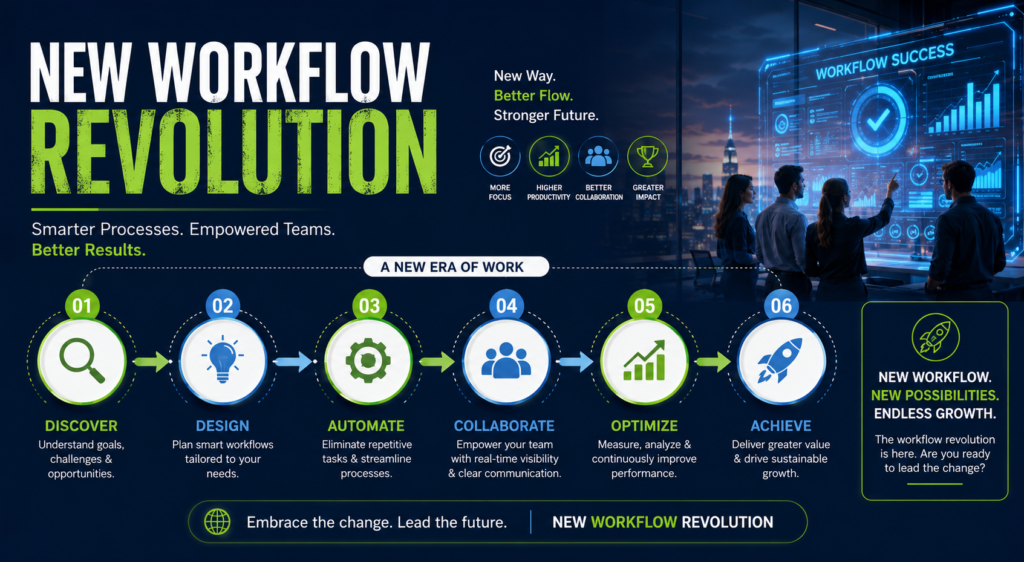
Many organizations still new workflow revolution rely on processes designed years ago, even though business environments have changed dramatically. Manual approvals, paper documents, spreadsheet tracking, and endless email chains often slow productivity and increase the risk of mistakes.
One major issue with traditional workflows is the lack of visibility. Managers may struggle to understand project status because information is scattered across multiple platforms or stored in isolated files. This makes it difficult to identify bottlenecks or make informed decisions quickly. New Workflow Revolution
Another challenge is scalability. As businesses grow, manual processes become increasingly difficult to manage. Hiring more staff to handle repetitive tasks is often expensive and inefficient. Modern workflows solve these problems by automating routine operations while allowing employees to focus on strategic and creative responsibilities. New Workflow Revolution
Technologies Driving the Workflow Revolution
Automation is one of the biggest forces behind the new workflow revolution. Businesses now use automation tools to handle repetitive tasks like sending emails, processing invoices, updating customer records, scheduling appointments, and generating reports. This reduces manual effort while improving accuracy. New Workflow Revolution
Artificial intelligence has taken workflow optimization even further. AI systems can analyze massive amounts of data, identify patterns, predict outcomes, and even recommend actions. Chatbots assist customers around the clock, AI-powered assistants summarize meetings, and intelligent software helps prioritize tasks based on urgency and business impact.
Cloud computing also plays a critical role. Employees can collaborate from anywhere using shared documents, cloud storage, and project management platforms. Remote teams can work together in real time without worrying about physical office limitations, making organizations more flexible and resilient. New Workflow Revolution
The Role of Automation in Modern Workflows
Automation has become the backbone of efficient business operations. Instead of spending hours performing repetitive administrative work, employees can rely on software to complete routine tasks automatically.
For example, when a customer submits an online form, an automated workflow can instantly send a confirmation email, notify the sales team, create a customer record, assign a follow-up task, and schedule reminders. What once required multiple employees can now happen within seconds.
Automation also reduces human error. Since repetitive tasks are handled consistently by software, businesses experience fewer mistakes in data entry, invoice processing, inventory management, and customer communication. This leads to better operational reliability and improved customer satisfaction.
Artificial Intelligence Is Changing the Way We Work
Artificial intelligence is no longer a futuristic concept. It has become an essential component of modern workflows across nearly every industry. AI helps businesses make faster decisions while reducing the workload placed on employees.
Machine learning systems continuously improve over time by analyzing historical data. They can identify customer behavior trends, forecast demand, detect fraud, recommend products, and optimize resource allocation with remarkable accuracy.
Generative AI has introduced another layer of innovation by helping professionals draft emails, summarize documents, generate reports, create presentations, write code, and brainstorm ideas. Rather than replacing human workers, AI often acts as a productivity partner that enhances creativity and efficiency.
Benefits of the New Workflow Revolution
One of the biggest advantages of modern workflows is improved productivity. Employees spend less time handling repetitive administrative tasks and more time focusing on innovation, customer relationships, and business growth. This creates a healthier balance between operational efficiency and strategic thinking.
Organizations also experience better collaboration. Team members can access shared information instantly, communicate through integrated platforms, and monitor project progress in real time. This reduces confusion while improving accountability across departments.
Another significant benefit is better decision-making. Modern workflow systems collect valuable data throughout every process. Managers gain access to dashboards, performance metrics, and analytics that help identify opportunities, solve problems quickly, and make informed strategic decisions.
Industries Leading the Workflow Transformation
Healthcare has embraced workflow automation to improve patient scheduling, medical record management, appointment reminders, and administrative efficiency. Doctors and healthcare professionals spend more time caring for patients instead of handling paperwork.
Financial institutions use intelligent workflows for fraud detection, loan approvals, compliance monitoring, customer onboarding, and transaction processing. Automation improves both speed and security while ensuring regulatory requirements are met.
Manufacturing companies benefit from connected production systems, predictive maintenance, supply chain optimization, and inventory automation. Retail businesses improve customer experiences through automated order processing, personalized recommendations, and real-time inventory tracking.
Challenges Businesses Must Overcome
Although the new workflow revolution offers enormous benefits, implementation is not always simple. One common challenge is employee resistance to change. Some workers worry that automation will replace their jobs or require them to learn unfamiliar technologies.
Another obstacle involves integrating new software with existing systems. Older business applications may not communicate easily with modern workflow platforms, requiring careful planning and technical expertise during implementation.
Cybersecurity also becomes increasingly important. As organizations rely more heavily on cloud platforms and connected systems, protecting sensitive business information requires strong security policies, employee training, and continuous monitoring against cyber threats.
How Companies Can Prepare for the Future
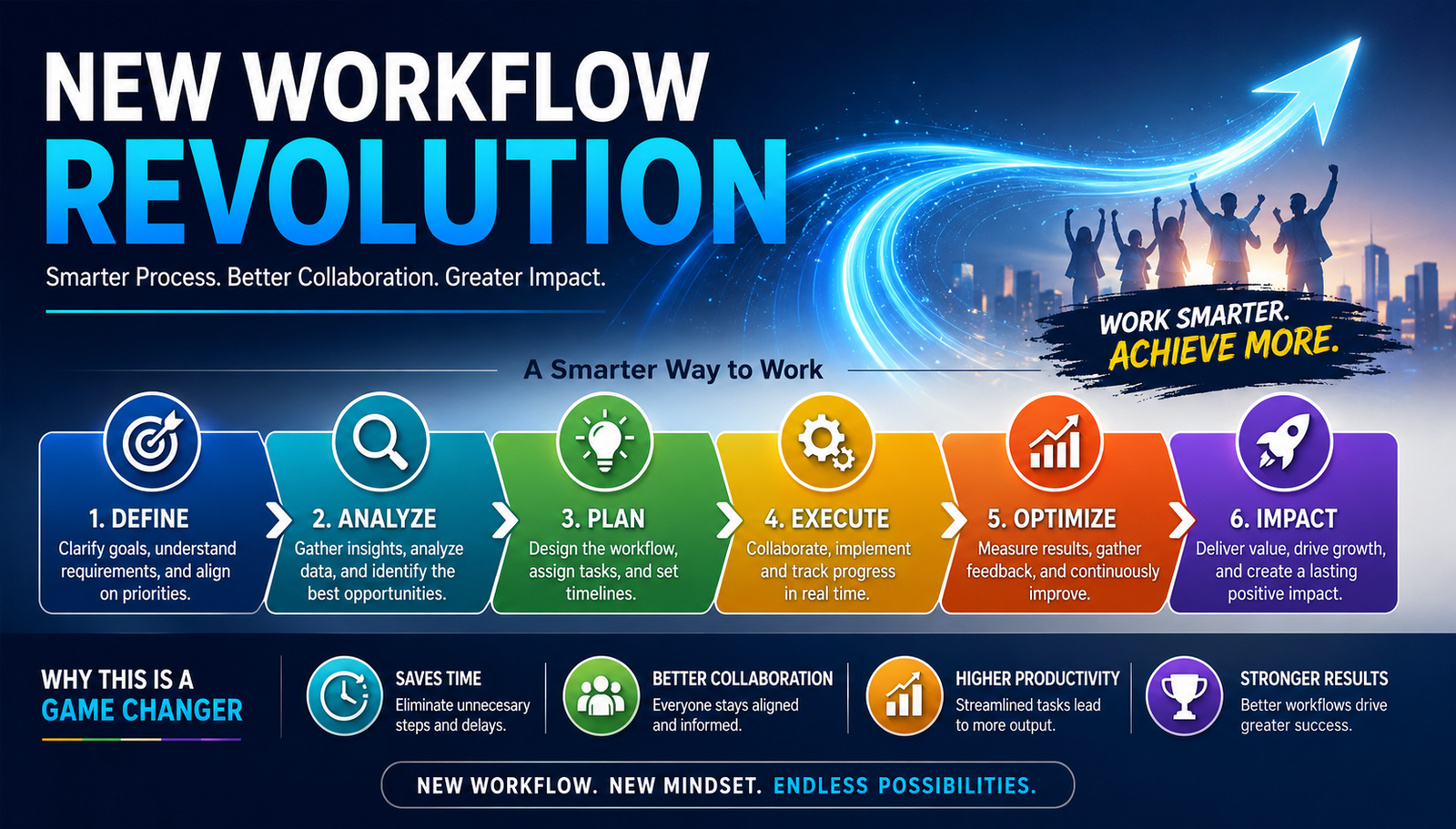
Businesses should begin by evaluating their current workflows and identifying repetitive tasks that consume unnecessary time. Mapping existing processes helps organizations understand where automation can deliver the greatest value.
Employee training is equally important. Technology adoption succeeds when people understand how new tools improve their daily work rather than simply replacing old methods. Continuous learning programs encourage staff to embrace innovation with confidence.
Organizations should also adopt a mindset of continuous improvement. Workflow optimization isn’t a one-time project. Businesses should regularly review performance metrics, gather employee feedback, and update processes as technology and customer expectations continue evolving.
The Future of the New Workflow Revolution
The future of workflow management looks increasingly intelligent and interconnected. Artificial intelligence will continue becoming more capable of handling complex decision-making while working alongside human employees rather than replacing them.
Low-code and no-code platforms will allow non-technical professionals to build custom workflows without programming expertise. This democratization of technology enables businesses to innovate more quickly while reducing dependence on specialized development teams.
Emerging technologies such as predictive analytics, intelligent assistants, robotic process automation, digital twins, and advanced collaboration platforms will further transform how organizations operate. Companies that adapt early will enjoy greater agility, improved customer experiences, and stronger competitive advantages.
Best Practices for Adopting Modern Workflows
Organizations should start small by automating one department or business process before expanding workflow automation across the company. This approach minimizes disruption while allowing teams to gain confidence with new technologies.
Choosing scalable software solutions is another important consideration. Businesses should invest in platforms that can grow alongside their operations rather than requiring complete replacement as organizational needs evolve.
Finally, measuring success through clear performance indicators ensures continuous improvement. Metrics such as processing time, employee productivity, customer satisfaction, operational costs, and error rates provide valuable insights into the effectiveness of workflow transformation initiatives.
Conclusion
The new workflow revolution represents one of the most significant shifts in modern business operations. Powered by automation, artificial intelligence, cloud technology, and real-time collaboration, today’s workflows enable organizations to work smarter rather than simply working harder. Businesses of every size can benefit from improved productivity, faster decision-making, enhanced collaboration, and better customer experiences.
While adopting modern workflows requires thoughtful planning, employee training, and ongoing optimization, the long-term rewards far outweigh the challenges. Organizations that embrace intelligent workflow systems position themselves for sustainable growth, greater innovation, and increased resilience in an increasingly competitive marketplace.
As technology continues to evolve, the new workflow revolution will only accelerate. Companies that invest in modern workflows today will be better prepared for tomorrow’s opportunities, ensuring they remain efficient, adaptable, and ready to thrive in the future of work.
You May Read Also: New England Road Trip

